Local roots. Global vision. Smart science.
This project improves thunderstorm prediction by fusing numerical weather prediction and satellite data using neural networks. It reduces data redundancy, improves accuracy and robustness, and lowers computational cost through optimized preprocessing, fusion, and validation methods. (Utilizing Earth Observation Data in Reaching Suslainable Developmenl Goals. DOI: https://doi.org/10.1016/8978-0-443-30204-6.00016-4 © 2026 Elsevier Ltd.)
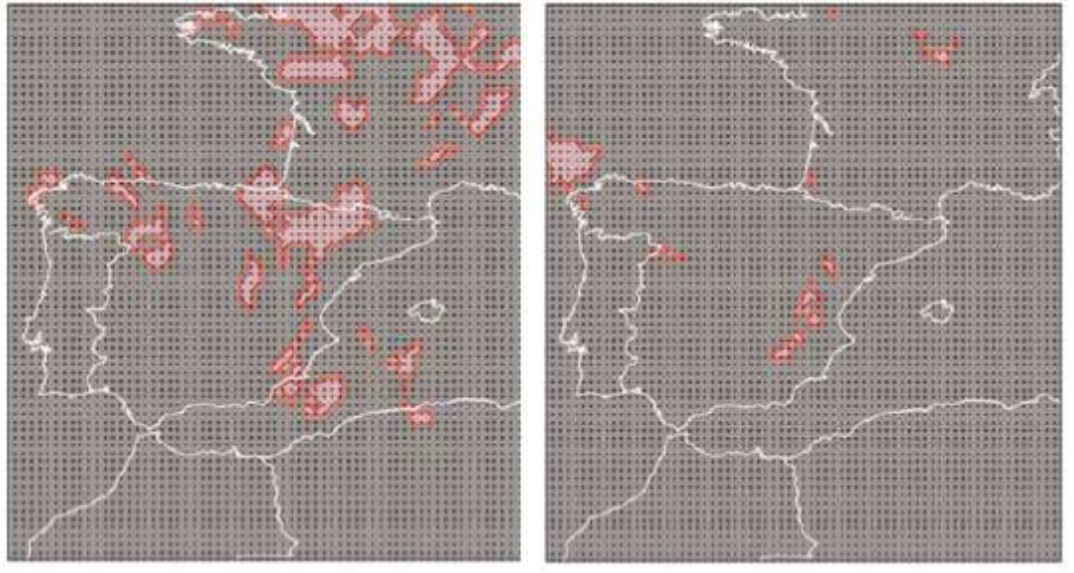
This project presents an advanced approach to short-term thunderstorm prediction by integrating numerical weather prediction (NWP) outputs with satellite-based storm observations using neural networks. The core objective is to improve prediction accuracy while significantly reducing computational complexity. A multilayer perceptron (MLP) neural network is enhanced through data fusion techniques that aggregate ensemble NWP forecasts, robust normalization strategies, optimized data partitioning, and k-fold cross-validation. Redundant ensemble inputs are fused via averaging, reducing data volume by up to 98% without sacrificing predictive performance. The model is trained and evaluated on European meteorological and satellite datasets, demonstrating improved AUC, true positive rates, and robustness against outliers and initialization sensitivity. Results show that the proposed methods outperform baseline and state-of-the-art approaches while maintaining feasibility for operational air traffic management applications. The study highlights a practical balance between accuracy, efficiency, and robustness in data-driven convective storm forecasting. (Utilizing Earth Observation Data in Reaching Suslainable Developmenl Goals. DOI: https://doi.org/10.1016/8978-0-443-30204-6.00016-4 © 2026 Elsevier Ltd.)
CENTRE FOR CLEANTECH AND BIOMASS RESOURCE EFFICIENCY
Contact us
info@ccbre.eu12 Mendeleev Blvd., Plovdiv 4000
Campus of the Agricultural University of Plovdiv