Local roots. Global vision. Smart science.
How one simple question — “Can we detect contamination before the waste enters the composting process?” — inspired us to build our own AI tool.
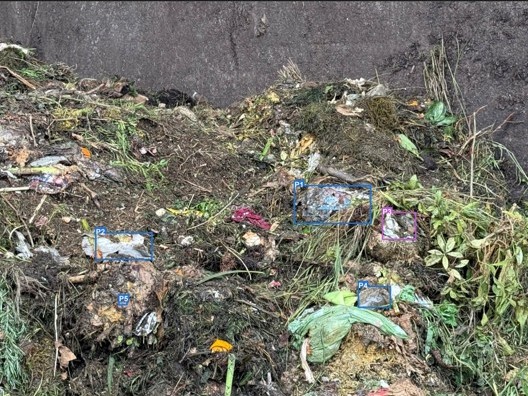
Green and biodegradable waste can become a valuable resource for the soil, but only if the material entering the composting plant is as clean as possible.
A single plastic bag or piece of packaging may seem insignificant in a full truckload of green waste. But when these contaminants repeatedly enter the process, they can accumulate and eventually end up in the finished compost.
This challenge prompted the team at the Centre for Cleantech and Biomass Resource Efficiency (CCBRE) in Plovdiv to ask a practical question:
Can we detect unwanted materials at the point of entry — quickly, consistently, and with the help of artificial intelligence?
That question marked the beginning of our AI system for green waste analysis.
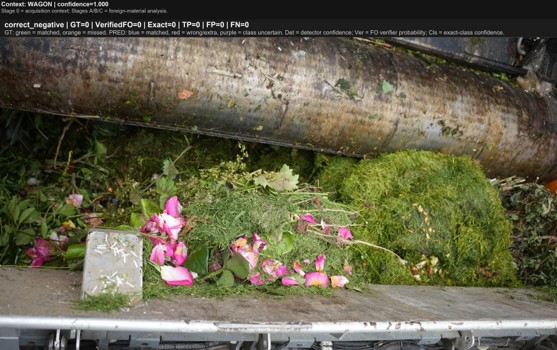
While researching the issue, we came across studies from Austria showing that even properly separated household organic waste contains, on average, around 2% unwanted materials, more than half of which are plastics.
This directed our attention to the point where contamination can be stopped earliest — when the waste is first received.
Today, this type of inspection is often carried out visually. An operator looks at the load and decides whether it should be accepted. The process is fast, but subjective: two people may assess the same load differently, and in many cases there is no traceable digital record of what was observed.
Our idea was simple: turn that visual inspection into a measurable and documented assessment.
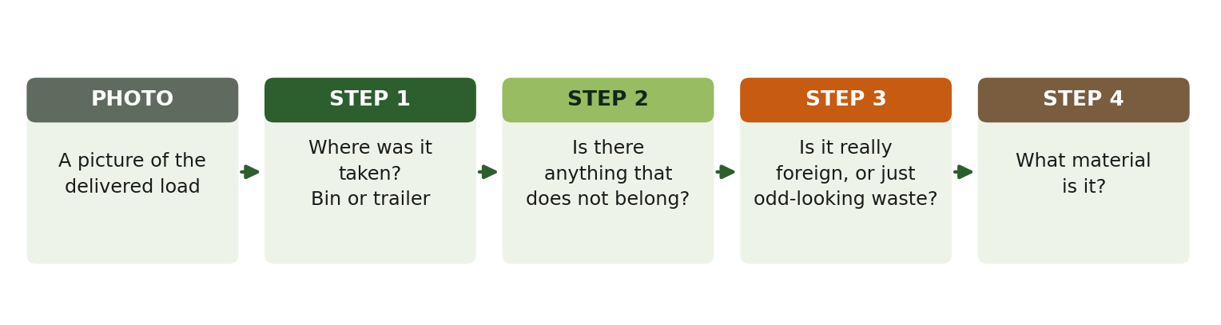
We developed a system that analyses a photograph of green waste and checks:
At the core of the system is YOLO, a computer vision technology designed for fast object detection. In our tests, YOLOv8 delivered the strongest results and became the basis of the current system.
We tested the system on 336 loads that it had not seen during training.
The results are promising:
The system still has a clear limitation: in heavily contaminated loads, it detects approximately 65 out of every 100 foreign objects.
This means that the tool can already support incoming waste inspections, but it should not yet be used to measure the exact amount of contamination in a load.
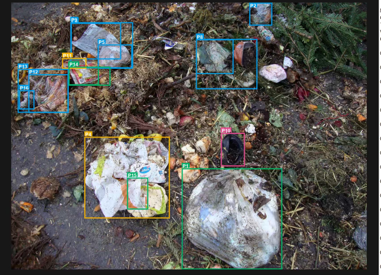
One of the most interesting challenges was distinguishing between a compostable bag and a conventional plastic bag.
At first glance, they can look almost identical, but their behaviour during composting is completely different. A compostable bag is designed to break down under specific composting conditions, while conventional plastic may simply fragment into smaller pieces and remain in the compost.
For this reason, we included this distinction in our model. It is important to stress, however, that this is visual AI classification, not a laboratory test or a certification procedure.
Today, the CCBRE AI Laboratory has already transformed the models into a working desktop application.
Our next goal is to bring the system directly to the composting site.
The idea is simple: take a photo of the load with your phone, send the image to the system, and receive information about whether unwanted materials are present and what they are.
To make this possible, we are planning a new photography campaign covering 23 types of unwanted objects across four types of green waste, photographed under different conditions, including lighting, distance, angle, and degree of burial.
Our current results come from one region and a limited period of time. The next important step is to test the system at other facilities, during different seasons, and under a wider range of real operating conditions.
Even today, the system can turn a subjective visual inspection into a consistent and traceable digital assessment. However, it is not yet designed to independently decide whether a load should be accepted or rejected.
For us, AI should be a tool for better decision-making, not a system that replaces human responsibility.
If you represent a composting plant, municipality, or waste management operator and would like to test the system on your own deliveries, we would be pleased to hear from you : info@ccbre.eu
Together, we can turn a simple photo taken with a phone into a practical tool for cleaner incoming material, higher-quality compost, and a more efficient composting process.
CENTRE FOR CLEANTECH AND BIOMASS RESOURCE EFFICIENCY
Contact us
info@ccbre.eu12 Mendeleev Blvd., Plovdiv 4000
Campus of the Agricultural University of Plovdiv