Local roots. Global vision. Smart science.
Healthy soils are the key to a sustainable agriculture. Compost and digestate improve the structure of the soil, increase its capacity to store water, protect it against erosion and strengthen the life within it. At the same time they bring back nutrients that would otherwise have to be bought abroad. At the Centre for Cleantech and Biomass Resource Efficiency (CCBRE) in Plovdiv we are working on organic and organo mineral fertilisers that make both of these benefits available on Bulgarian fields.
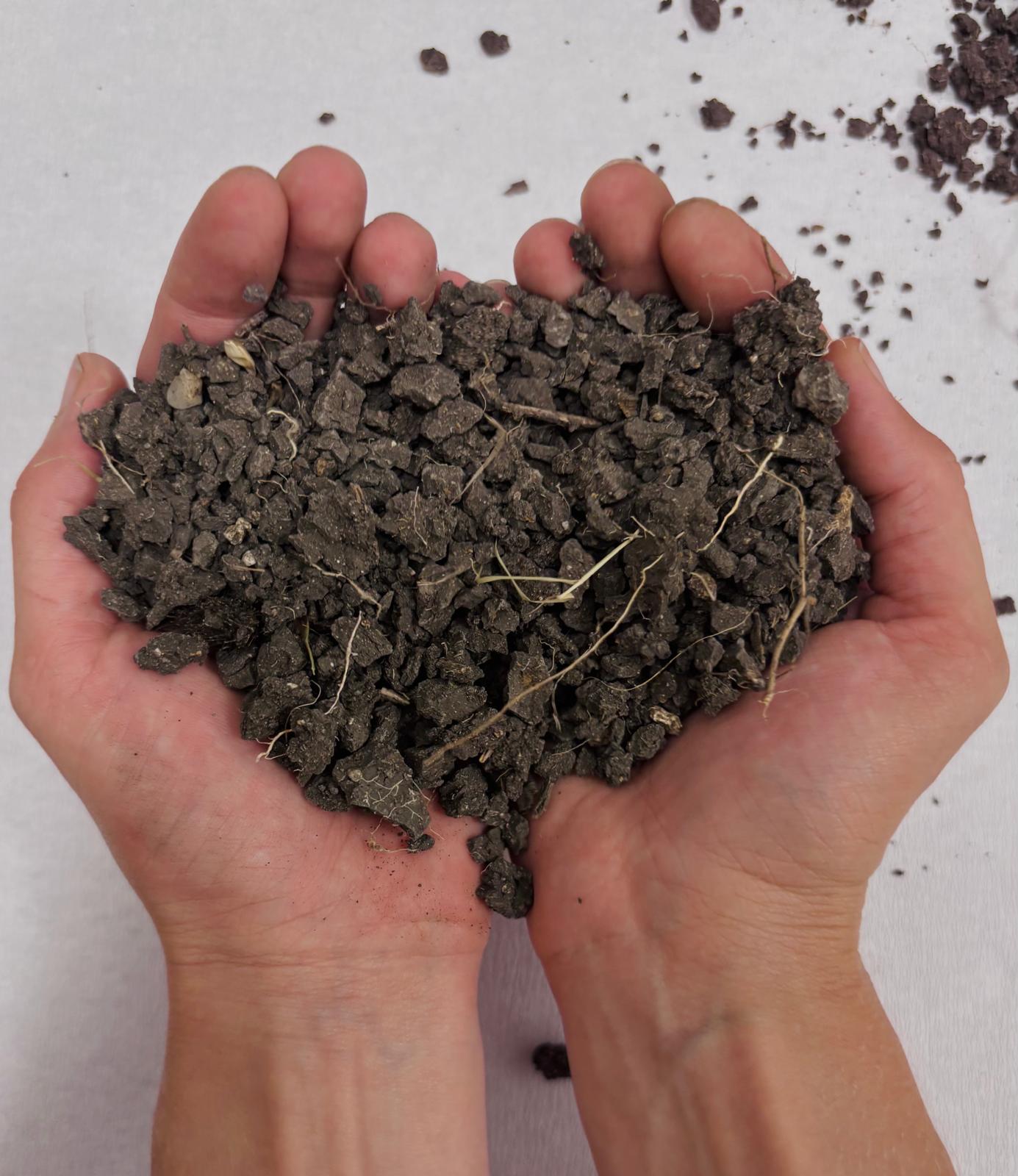
With longer dry periods and rising temperatures, the ability of the soil to store water becomes more and more important. One simple and at the same time very effective measure is the use of organic fertilisers such as compost or solid digestate.
Compost and digestate are made from organic materials such as garden waste, leaves or kitchen waste, which are turned into an organic fertiliser by natural processes of decomposition, as the two boxes below explain. When compost and digestate are spread on farmland or in gardens, the microbes of the soil break them down and mix them into the soil, and stable clay humus complexes are formed. These improve the structure of the soil, which becomes looser, more crumbly and better aerated. Humus supports the life in the soil: earthworms, fungi and countless micro organisms continuously improve its fertility. A living soil is more resistant to extreme weather and is the basis for stable yields. At the same time its ability to take up water and nutrients and to hold them over a longer period increases.
This advantage becomes particularly visible during the dry months of the summer. Soils that are rich in humus and contain stable clay humus complexes act like a sponge. They take up rainfall quickly, hold the water and release it gradually to the roots of the plants. Crops therefore remain supplied with moisture for longer, even when it does not rain for several days or several weeks. At the same time evaporation is reduced and the risk of drought stress becomes smaller.
Compost also makes an important contribution when it rains heavily. Soils with a high content of humus can absorb considerably more water than compacted soils or soils that are poor in humus. The rainwater infiltrates better, which reduces surface runoff, the erosion of soil and the risk of flooding. In this way compost contributes not only to the health of the plants, but also to the prevention of erosion and to the protection against floods.
There is a second argument, and in Bulgaria it is becoming just as important as water. Mineral fertilisers are almost entirely imported, and their price follows the price of natural gas and the situation on the world market. Every tonne of nitrogen, phosphorus and potassium that returns to the field in the form of compost or digestate is a tonne that does not have to be bought abroad. Organic fertilisers therefore do two things at the same time. They build up the soil, and they make farms less dependent on a market that they cannot influence.
Together with partners from research and from industry CCBRE develops organic and organo mineral fertilisers from the residual materials that the region already produces, which means green waste, residues from the processing of food and the material that remains after the production of biogas or from waste water treatment. Our earlier work in Switzerland together with the University of Applied Sciences and Arts Northwestern Switzerland has shown that phosphorus in particular can be recovered from residues from the waste water treatment in a form that plants can take up, and can be returned to the field. We are now transferring these results to Bulgarian conditions, to Bulgarian soils and to the crops that are actually grown here.
Experts therefore consider the use of compost and digestate to be an important element of an agriculture that is adapted to the climate and of a sustainable horticulture. Whoever uses compost and digestate regularly invests not only in the fertility of the soil, but also in its ability to store water and to supply plants reliably during dry periods, and keeps a part of the fertiliser budget within the region.
Companies, farms and municipalities that would like to test such fertilisers on their own land are very welcome to contact us.
Contact : info@ccbre.eu
Further reading
Compost, soil structure and carbon storage, in English: Fact sheet of the European Compost Network
Advantages and limits of compost in practice, in English: Fact sheet of the Best4Soil network
The Bulgarian rules for the separate collection and the treatment of biowaste, in Bulgarian: Ordinance published by the Executive Environment Agency
CENTRE FOR CLEANTECH AND BIOMASS RESOURCE EFFICIENCY
Contact us
info@ccbre.eu12 Mendeleev Blvd., Plovdiv 4000
Campus of the Agricultural University of Plovdiv